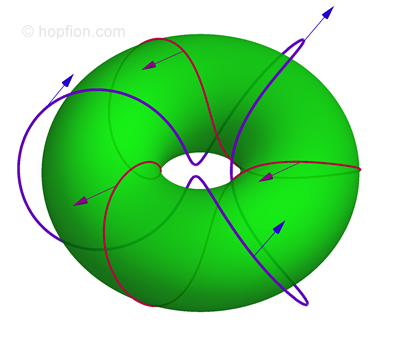
Liquid crystals represent the very first physical media where the variant of Hopf fibration was observed [Y. Bouligand, "Recherches sur les textures des états mésomorphes. 6 - Dislocations coins et signification des cloisons de Grandjean-Cano dans les cholestériques", Journal de Physique 35, 959 (1974) ref]. The space of the order parameter in a liquid crystal is a real projective plane (not a sphere). However, since the sphere is a universal cover of the real projective plane, the third homotopy groups are the same for both manifolds. Thus, the corresponding topological invariant is the version of Hopf invariant [Y. Bouligand, B. Derrida, V. Poenaru, Y. Pomeau, G. Toulouse "Distortions with double topological character: the case of cholesterics", Journal de Physique 39, 863 (1978) ref].
Hopf fibrations, geometrically confined between glass substrates have been extensively studied [B.G. Chen, P.J. Ackerman, G.P. Alexander, R.D. Kamien, I.I. Smalyukh "Generating the Hopf Fibration Experimentally in Nematic Liquid Crystals" Phys. Rev. Lett. 110, 237801 (2013) ref], [P.J. Ackerman, J. van de Lagemaat, I.I. Smalyukh "Self-assembly and electrostriction of arrays and chains of hopfion particles in chiral liquid crystals", Nat. Comm. 6, 6012 (2015) ref], [P.J. Ackerman, I.I. Smalyukh "Static three-dimensional topological solitons in fluid chiral ferromagnets and colloids", Nat. Mater. 16, 426 (2017) ref], [P.J. Ackerman, I.I. Smalyukh "Diversity of knot solitons in liquid crystals manifested by linking of preimages in torons and hopfions", Phys. Rev. X 7, 011006 (2017) ref], [J.-S.B. Tai, P.J. Ackerman, I.I. Smalyukh "Topological transformations of Hopf solitons in chiral ferromagnets and liquid crystals", PNAS 115, 921 (2018) ref].
In [J.-S.B. Tai, I.I. Smalyukh "Three-dimensional crystals of adaptive knots", Science 365, 1449 (2019) ref, arXiv:1911.09160v1] it was first demonstrated that the Hopf fibration in the liquid crystal may be stable without the impact of confinement. The corresponding formations were particles able to travel in all three spatial dimensions. Thus, the hopfion was demonstrated.
Demonstration of both the equilibrium structure and topology-preserving out-of-equilibrium evolution of hopfions: [J.-S.B. Tai, J.-S. Wu, I.I. Smalyukh "Geometric transformation and three-dimensional hopping of Hopf solitons", Nature Communications 13, 2986 (2022) ref].
On-demand generation of confined hopfion textures using a low-power light beam: [S. A. Shvetsov, D.D. Darmoroz, A. Vasil’ev, T. Orlova, I.S. Lobanov, M. Rafayelyan "Light-induced isotropic pen for generation of topological solitons and hopfion–toron transition in frustrated chiral nematic films", Chaos, Solitons & Fractals 199, 116905 (2025) ref].
Fusion and fission of hopfions: [D. Hall, J.-S.B. Tai, L.H. Kauffman, I.I. Smalyukh "Fusion and fission of particle-like chiral nematic vortex knots", Nature Physics 22, 103 (2026) ref].
This page is not complete and if you find inaccuracies, if you have any comments or additional material - do not hesitate to contact us.